
Job Searching
The great thing about healthcare is that there are often more positions open than there are applicants. This can mean great job security for you! But just because there can be lots of open positions, it doesn’t mean that you will get, or keep, a job if you do not act in a professional manner. Professionalism means that you work by the set of standards you learn from this textbook and in your nursing assistant course to gain and retain employment. To land that perfect job, you need to follow a certain set of standards that are professional. Those standards will get your application noticed, can get you an interview, and can help you find your dream job!
There are several ways to find job openings. One place is online at employment websites like Careerbuilder or Indeed. The job posting will generally tell you how to upload your resume or provide you with an online application.
There are local job center offices that can assist you in finding current openings if you are not Internet savvy or are uncertain as to how to start the job hunt. While at the job center, take the time to learn how to do Internet job searches on your own. Job center personnel may also be able to help you with the application and resume-writing process.
You can also go to specific company websites. If you know what companies you are interested in possibly working for, just visit the “employment” or “careers” page of their sites. These sites will give you a detailed description of the jobs that are open. Bookmark these sites to keep checking back for new openings because the healthcare job market moves quickly!
Talk to friends, family, and neighbors. Many jobs are out there but are just not advertised. By finding a job through “word of mouth,” you may be the first person to apply for that position. You may be the only person to apply for that position! When you go in for an interview, make sure to say who referred you.
Applications
An application is a very basic tool that helps employers sort through potential employees. This is the tool they use to determine who will be called in for an interview. If you fill out an application the right way, you can get the first foot in the door. That first foot is an interview.
Applications can be found in the human resources office of the company where you are applying. You can physically go to the company’s human resource office to request an application, although this can be very time consuming if you are applying to multiple companies and most organizations no longer use paper applications. A more time efficient way is to find the application online and electronically submit it to the organization.
It is helpful to keep a list of commonly requested items such as:
- the dates of your education, starting from most current to the past;
- current certifications like nursing assistant and CPR;
- Additional training you may have received from past employers;
- the dates, names, and contact information of your past employers;
- personal and academic accomplishments; and
- names and phone numbers of personal and professional references.
About 1 week you submit your resume or application, make a follow-up phone call. This will tell the company that you are very interested in the position. Your phone call could include topics such as verifying that the company received your application materials, asking when interviews will be held, and asking the anticipated hiring date for this position. Be courteous and polite. Thank the person who answers the phone for her time.
Some companies may store all of your information for any current or future openings that match your qualifications after you upload a resume or fill out the online application.
Resume
Taking the time to write a resume shows potential employers that you are serious about a job and that you are a professional. A resume adds to your application. A resume is a formal document that gives potential employers a quick glimpse of you as a professional. The resume should include information about your academic and work history, starting with the most current information. You can also include personal accomplishments that are relevant to the job. These accomplishments could be winning a community award or any volunteer work that you do.
There are many different online templates to pick from to help you write a resume. You can also seek help at job centers, your high school or community college, and the local library. Here are some basic tips to use when picking out a format.
Use a font that is large enough and easy to read. Place your name and contact information at the top of the page in a larger font for easy retrieval. Do not include personal information such as height, weight, marital status, ethnicity or how many children you have.
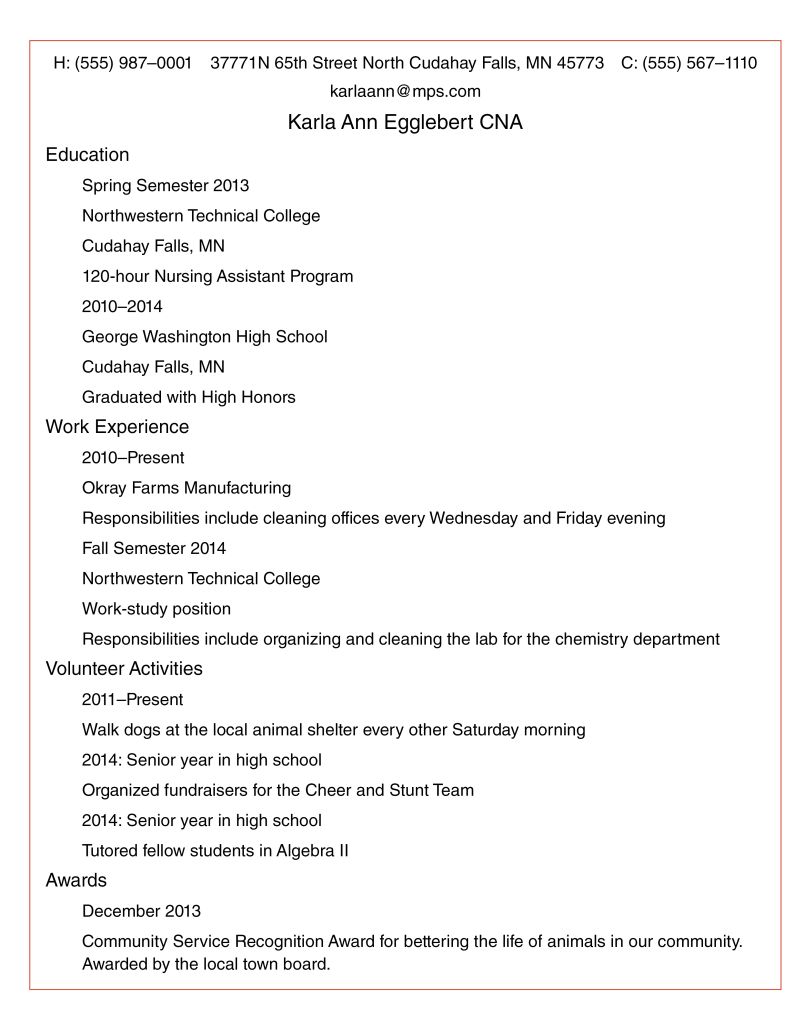
An example resume.
A resume is often accompanied by a reference list. A reference list is a separate piece of paper that lists all of your personal and professional references. A reference is a person who can tell a potential employer about your accomplishments, work history, personality traits, reliability, professionalism, and other characteristics. Potential references might include previous employers, former teachers, or community members who know you through volunteer activities. Before listing an individual as a reference, be sure to ask her permission. List the person’s name and professional title or how you otherwise know the person. Include an address, work phone number, and e-mail address for each reference.
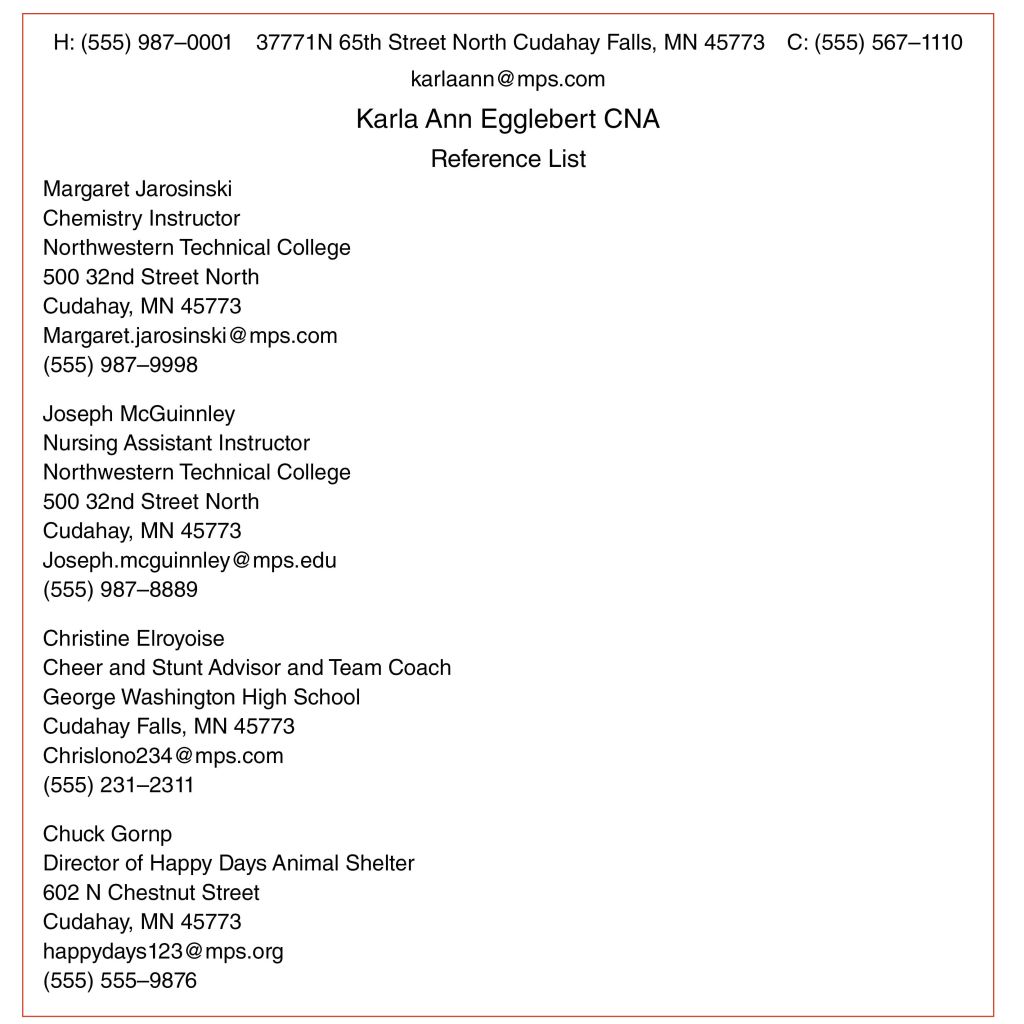
An example of a reference list.
Interviewing
After you submit an application or resume, you will probably hear from the employer within a few weeks to schedule an interview. The employer may extend an invitation to interview. You will need to work with the employer’s schedule. This may mean rearranging your own schedule. Do so without complaint.
There are a few things you will want to think about before the interview. Think about your transportation. Do you have a reliable way to get to the interview? Always have a backup plan if this transportation is not available when you need it. Check out public transportation schedules and routes to see if that can work as your backup, or contact a friend or relative to be “on call.” Next, think about how much time it will take to get to the interview. Always allow extra time for traffic, emergencies, or construction delays. If it takes 15 minutes to get to the interview, leave 30 minutes early. Employers like to see promptness. If you are not sure how long it will take, then make a trip and time yourself prior to the interview. Go at the same time of day as your interview so you know what traffic will be like.
Another item to think of is what you will wear. You should never go to an interview in jeans, shorts, or other very casual clothes. It is professional to appear in business-casual clothes, like dress pants and a button-down shirt. Be conservative. Style your hair in a way that is neat and pulled back from your face. Do not wear a large amount of makeup, perfume, or cologne.
Prior to the interview, start to think of answers to the most commonly asked interview questions. This will prepare you and make you feel more comfortable during the interview process. You can ask a friend to go through these questions with you, or you can think about the answers by yourself. Here are some of the most commonly asked questions:
- Tell me a little about yourself.
- What did you like most about your last job? What did you least like?
- What are your strengths? What are your weaknesses?
- Why do you want to work for our company?
Also think about some questions you may want to ask the interviewer. Do not ask about wages or time off at the interview; there will be an appropriate time to do that later.
Try to be about 10 minutes early for the interview. Bring another copy of your resume and reference list. Shake hands with the interviewer and make good eye contact upon introductions. Most of all, have a positive attitude!
Accepting and Resigning From a Position
If all goes well at the interview, you are likely to be hired for the position. When the offer is extended to you and before accepting the position, you may want to find out a bit more. Ask what the start date would be, how many hours per week are being offered, what the starting wage would be, and if there are any other benefits being offered, such as retirement fund matching or educational reimbursement. If you agree to the terms of the job offer, by all means, accept the position! You can accept the job verbally when the human resources representative calls you. You may also need to go to the office to sign paperwork.
Once you have secured the position, you will need to complete a few more steps to make sure you retain that position. If you have small children, ensure that you have proper child-care arrangements made prior to starting your job. You will also need to secure a backup child-care provider when the primary provider may not be able to watch the children. Make sure that you have reliable transportation. Plan your daily schedules and errand running around your work schedule.
After accepting the position, you may need to resign at another company if you are currently working. The proper way to resign is to submit a dated letter to the employer stating that you will be leaving the organization and the last date of work. The standard amount of time to continue working for the current employer is 2 weeks from the date of your letter.
If you leave abruptly or under bad conditions, there may be repercussions. Remember, you will need past employers as references for future jobs. If you do not have a good relationship with a past employer, you will not get a good reference. If you omit that employer on applications, then future employers will question the time lapse in employment. This can serve as a red flag to potential employers, which means you might not get the position you want.